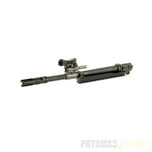
Geissele
Geissele Cold Hammer Forged 11.5" 5.56 NATO Gov't Profile Chrome Lined Barrel
$349.00
Out of Stock



HK 21 Barrel - 7.62 NATO - 17.7 inch - Original Pattern, Machine Gun Type
WITHOUT Attached Hardware
The Heckler & Koch HK21 was Germany's answer to a hard question: how do you take the most respected battle rifle of the Cold War and turn it into a belt-fed machine gun that a single soldier can carry, feed, and keep running through a firefight? The answer, introduced in 1961, was to build the HK21 directly on the G3's roller-delayed action - and then add the two things a rifle does not need but a machine gun cannot live without: a belt-feed mechanism and a quick-change barrel.
Portugal adopted it as the m/968, it served across dozens of armed forces, and decades later it remains one of the most sought-after roller-delayed builds in the collector and Class-III community. If you are reading this page, you already know how few correct HK21 barrels exist in the world - and you know exactly why a spare matters.
Why the HK21 Eats Barrels - and Why a Spare Is Not Optional
The HK21 runs at a cyclic rate in the neighborhood of 800-900 rounds per minute. That is the part that sells the platform, and it is also the part that destroys barrels. Sustained automatic fire - or the very fast semi-auto strings these guns are built to deliver - dumps an enormous amount of heat into the bore in a very short span of time. As the steel climbs in temperature, several things start happening at once: the throat begins to wash out, the bore surface heat-checks and develops fine cracking, accuracy falls off, and the risk of a chambered round cooking off climbs. Push it far enough and the barrel can actually warp - the metal bends as it expands unevenly, and once a barrel is warped it is finished. This is not a flaw in the design. It is the reason the HK21 was engineered with a quick-change barrel in the first place. Machine gunners do not nurse a hot barrel; they swap it. A second barrel on the bench is the difference between a gun you can run hard and a gun you are babying because you only have one tube left in the world.
Whether you are feeding a transferable HK21, a registered sear host, or a faithful semi-auto build, having a correct spare on hand means you can actually use the weapon the way it was designed to be used - and protect the irreplaceable original barrel that came with your kit.
How This Barrel Is Made
This is not a hobby-shop blank turned down on a lathe. The barrel begins as a cold-hammer-forged blank sourced from a United States military supplier - the same forging process used on issued service-weapon barrels, which work-hardens the steel and produces a denser, longer-living bore than conventional button or cut rifling alone. The blank is 4150 chromoly vanadium steel, the ordnance-grade alloy chosen specifically for its strength and heat tolerance under exactly the kind of punishment an HK21 delivers.
The bore is chrome lined - a deliberate, correct choice for a sustained-fire weapon. Chrome lining resists the throat erosion and corrosion that come with high-volume shooting and makes the bore far easier to clean after a hard day. The exterior is Parkerized to the original German specification rather than coated in black nitride. This is intentional: a Parkerized phosphate finish handles the heat of full-auto fire better than nitride at the surface, and it keeps the barrel faithful to how the originals were actually finished. The chamber is a fluted chamber, just as on the originals - the flutes float the case on a thin cushion of gas during extraction, which is fundamental to how the roller-delayed system reliably pulls a case at this cyclic rate.
Specifications
Quality Control & Process Standards
Every barrel is inspected at 100x magnification before release, and the processing is held to documented military standards rather than left to chance:
The first verified owner to run one summed it up plainly: This barrel was an instant lock up. It fit perfectly without any play. The finish and machining was great.
Without Hardware - Read This Before You Order
This listing is for the bare barrel only, in the original HK21 pattern with no attached hardware. If your kit's existing hardware (front sight base, shroud, gas-system components, and related parts) is in serviceable condition, this is the configuration you want - you reuse what you have and simply replace the consumable part: the barrel itself. If you instead need a barrel with hardware attached, contact us and we will point you to the correct option.
Optional Custom Threading for Your Suppressor
The barrel ships with the original German M15 x 1 muzzle thread. If you run a suppressor with a different thread pitch, custom threading to match your existing can is available for an additional $50 - just ask when you order and we will set it up so your suppressor mounts correctly out of the box.
A Safety Feature Worth Understanding: The Barrel Pin
There is a pin at the rear of every HK21 removable barrel, and it is there on purpose. It is a safety feature designed to help prevent removing the barrel while a live round is in the chamber. The pin is offset in the chamber face of the barrel and enters a corresponding hole in the face of the bolt head. Because the pin is offset and protrudes into the bolt face when the bolt carrier group is closed and in battery, it physically prevents the barrel from being rotated and removed from the trunnion. To change the barrel, the bolt carrier group must be pulled rearward - out of battery, and preferably locked open - which extracts any live round that may be in the chamber. With the bolt carrier group locked to the rear, the barrel rotates freely and can be removed or installed. In short: the design will not let you swap a hot barrel without first clearing the chamber. That is exactly the behavior you want on a belt-fed gun.
Availability & Lead Time
This is a current in-production item. Not sure which configuration fits your build? That is what we are here for. Reach out and tell us what kit you are running and how you intend to shoot it, and we will help you land on the right barrel and the right supporting parts the first time.
Federal, state, and local law govern the ownership and configuration of machine guns, registered sears, short-barreled firearms, and suppressors. It is the buyer's responsibility to ensure that this barrel and your intended configuration are legal in your jurisdiction. Specifications are provided by the manufacturer and are subject to normal manufacturing variation.
Geissele

Geissele