
The Mk18 Build Sheet: Mod 0, Mod 1 & Current Issue | CCC
Posted by Charlie's Build Team on May 16th 2026
Last updated: May 16, 2026
The M4-Delta carbine of 1993 predates the Mk18 lineage documented here; that earlier system is covered in 1993: Delta Had Already Built the Modern Carbine.
The Mk18 Build Sheet:
How Crane's Hacksaw Became the Most-Cloned SBR

This Build Sheet is the product of years of CCC shop work, dozens of cross-referenced primary sources, conversations with operators who actually carried these rifles, and SME video intelligence from Garand Thumb, Modern Tactical Shooting, Foghorn 5, Small Arms Solutions, Classic Firearms, Administrative Results, and others. We have done our best to get the technical record right.
We have probably made some mistakes. Some are errors in translation across sources — Crane, USSOCOM, USASOC, and NSW use overlapping but not identical terminology, and the documented public record is incomplete. Some come from too much data and a missed detail. And on a platform that has been in service for twenty-six years across dozens of units, configurations, and operator builds, there are people with hands-on experience whose rifles looked slightly different from the canonical configurations we describe.
Treat this Build Sheet as a work in progress and as a good clone discussion document — not "the authority." If you spot something wrong, we want to know. The post will get better.
Email sales@charliescustomclones.com with the subject line "Mk18 blog edit".
Crane's Hacksaw: How the CQBR Was Born
Belowdecks on a Cyclone-class patrol craft, a SEAL checks the dot on his Aimpoint, taps the SureFire bezel against his thigh to confirm activation, and waits for the call. The rifle in his hands is 26.5 inches long, suppressed, and the barrel was hacksawed to length on a workbench in Indiana before he was old enough to enlist.
In 1999, gunsmiths at Naval Surface Warfare Center Crane took a Colt M4 barrel, cut roughly four inches off the muzzle, re-threaded it, and bolted on a quad-rail. They were solving one problem: how to mount the KAC NT4 suppressor on a SEAL's carbine without the can fouling the bayonet lug. The hacksaw fix became the Mk18 Mod 0 — the most-cloned short-barreled AR in the United States.
Twenty-six years later, the platform is still in service. Same 10.3-inch Colt barrel. Different rail, different gas port, different lower — but the same DNA. Mod 0 to Mod 1 to the URG-I family the community calls Mod 3. Naval Special Warfare, USSOCOM, Coast Guard MSRT, U.S. Navy EOD, AFSOC, MARSOC, NCIS, and now Ukrainian assault elements all carry some version of it.
Call it a build sheet wrapped in a story. The Mod 0, the Mod 1, the rare 12.5" GL/SSC, and the current-issue M-LOK configuration — every era, every variant, with the parts-level details that separate a clone-correct upper from a rifle wearing the right name and the wrong components. The Colt-versus-DD-commercial distinctions. The Crane-process quirks no civilian article carries. The 0.062" → 0.070" gas port retune. The Block I vs Block II accessory generations. The configurations operators carry in 2026, not the ones marketing copy claims.
The Mk18 Mod 0: Quad-Rails and the Crane-Cut Barrel
The Mk18 Mod 0 is the original 10.3-inch CQBR configuration fielded by U.S. Naval Special Warfare in 2000 — Colt M4 upper, Crane-cut Colt barrel, A-frame F-height front sight base, and a Knights Armament quad-rail handguard.
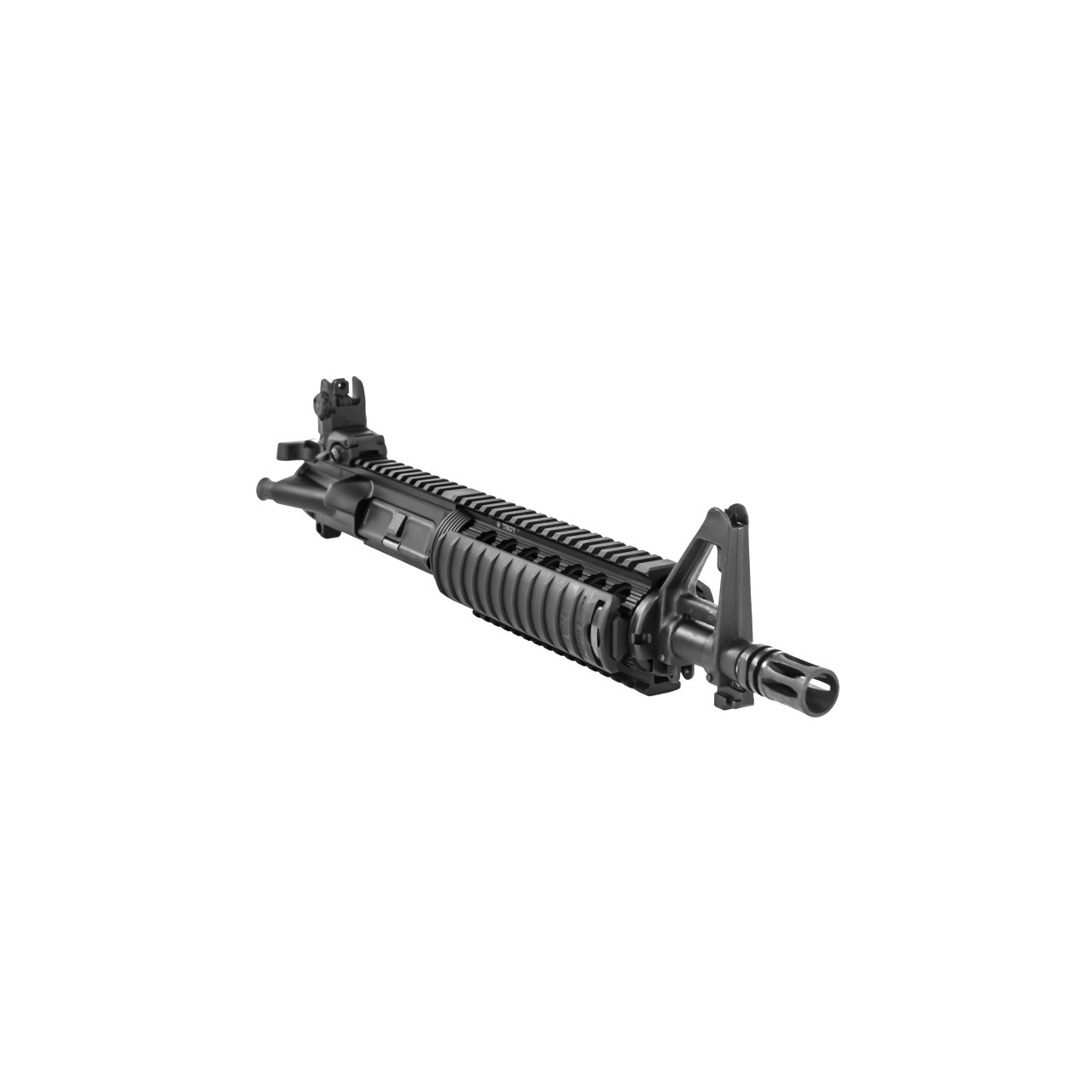
NSWC Crane fielded the Mk18 Mod 0 to the Navy in 2000. SEALs got the first uppers — initially LMT-produced, mounted on recycled M16A1 lowers carrying the Crane stamp, with 4-position stocks and CQD plates. Army Special Forces ODAs started seeing them around 2004, first issued only to hostage rescue teams in Iraq while the rest of SF kept running MP5s for low-vis work.
The Mod 0 came into service at exactly the moment U.S. SOF needed it. The post-9/11 operational tempo demanded a carbine that could clear ships, breach compounds, and work in stairwells — environments where a 14.5" M4A1 was too long and an MP5 was too underpowered. The 10.3" CQBR fit that gap. By 2003, Naval Special Warfare was running Mk18s on every VBSS mission. By 2005, the rifle was standard issue for SEAL teams across both coasts, and the Coast Guard's Maritime Security and Safety Teams had picked it up for high-risk boarding. By 2006, NCIS agents deploying to active combat zones in Iraq carried it. The platform spread sideways through the U.S. national-security inventory faster than the SOPMOD program managers anticipated.
The M4 flat-top — the prerequisite that made the Mk18 possible
The Mk18 doesn't exist without the M4 flat-top upper. The original M16A1 and M16A2 carried integral A2-style carry handles with fixed iron sights — no rail, no easy way to mount optics or lights. A flat-topped upper with a MIL-STD-1913 Picatinny rail running its length was the prerequisite for any modular accessory program, and the path to that standard took most of the 1990s.
The flat-top concept came out of work by Richard "Dick" Swan and his company ARMS — Atlantic Research Marketing Systems. Swan founded ARMS in 1980 and began standardizing Weaver-style rail mount designs in the early 1980s. Picatinny Arsenal asked Swan to help develop a standardized rail interface; Swan did the actual design work and held the patent (granted 1995). Picatinny got the naming rights; ARMS got the engineering credit. The M4A1 transitioned to the flat-top upper in the mid-1990s, and by the time SOPMOD Block I was finalized in the late 1990s, every SOF carbine in the kit was built on a flat-top. The Mk18 inherits that architecture: it is, structurally, an M4A1 flat-top upper with the barrel cut short and a KAC rail clamped over it. The flat-top Picatinny rail is where the optic mounts; the quad-rail handguard is where the IR laser, weapon light, and vertical grip mount. Without both, the modern SOPMOD carbine concept doesn't work.
The Crane-cut barrel
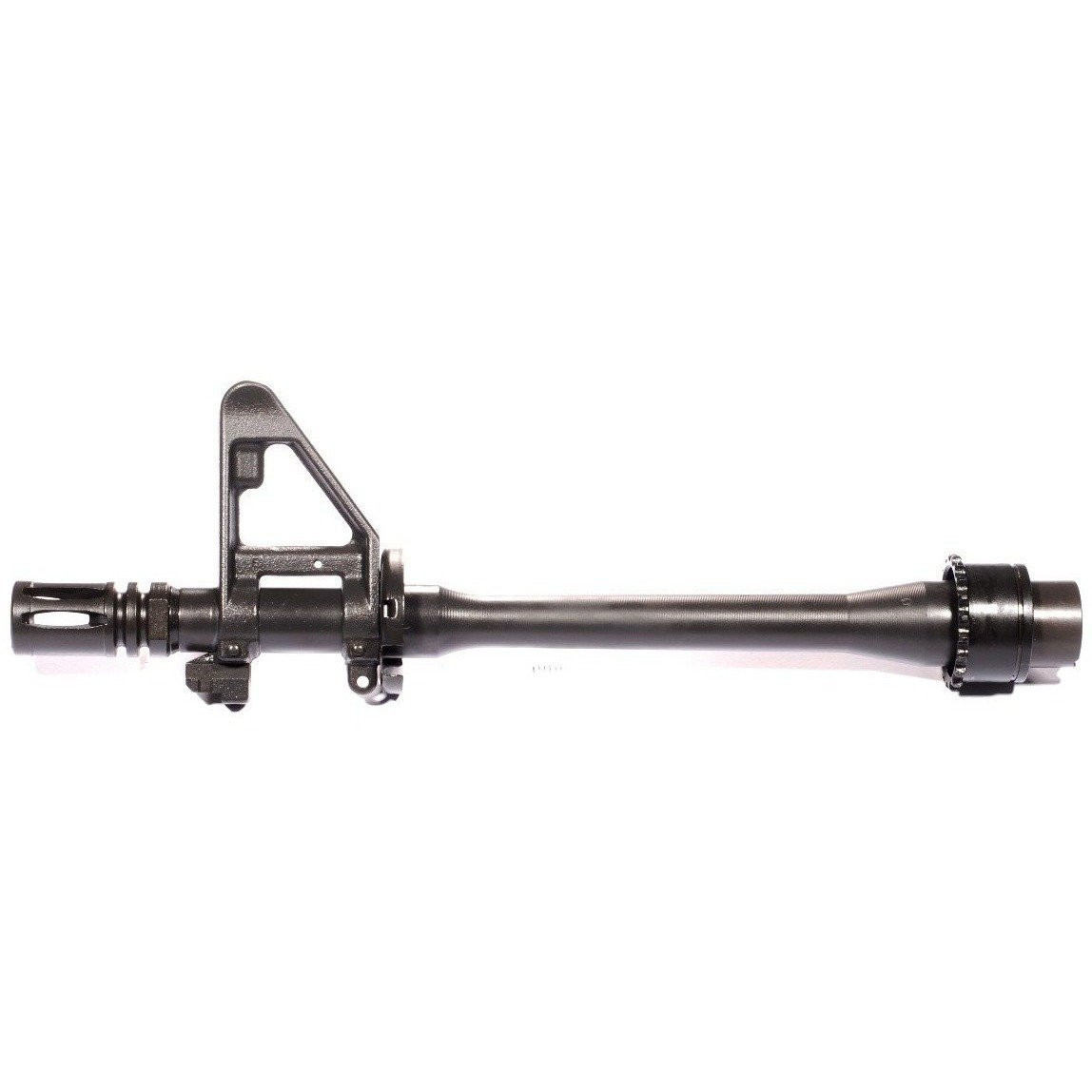
The early barrel work was hand-fitted. Crane armorers took standard 14.5" Colt M4 barrels, cut them to 10.3", re-threaded the muzzles, and balanced each rifle with H, H2, or H3 buffers depending on ammunition. Colt's manufacturer marks sit on the muzzle end, so cutting to 10.3" removed them entirely. Original Mod 0 barrels carry no Colt stamps — the only origin tells are the date stamp at the front sight base and the "W" or "G" roll-mark near the chamber extension. Colt later produced purpose-made 10.3" Government-profile barrels to supply the program directly: chrome-lined, 1:7 twist, F-height FSB factory-pinned.
The rear sight evolution — chopped carry handle to LMT
One detail almost no civilian post gets right. The earliest Mod 0 rifles used chopped-off A2 carry handles as a field-expedient rear sight — operators or Crane armorers sawed standard A2 carry handles down to just the rear sight assembly and clamped that onto the flat-top rail. Crude, in-shop, and it worked. The cut handles were inconsistent in finish and dimension, but they put a usable iron sight on the rifle before purpose-built alternatives were available.
Lewis Machine & Tool produced the purpose-built replacement — the LMT L8A fixed rear sight, a commercially-manufactured A2-pattern rear sight built for flat-top Picatinny mounting. The L8A was the Navy-specified rear iron sight for the Mod 0 by the early 2000s, well before the broad GWOT fielding wave. The chopped carry handles persisted in some hands and reappear in clone builds as a period-correct touch for the earliest 2000–~2002 configurations, but the L8A is the canonical Crane-spec rear sight for the bulk of the Mod 0 operational era.
KAC RIS vs. KAC RAS — the distinction clone builders blow
Both are Knights Armament quad-rails. They are not synonyms, and getting it wrong on a Mod 0 build tags it as a near-clone instantly.
- KAC RIS (Rail Interface System) — first-generation, clamps to the handguard cap. The original SOPMOD Block I rail. Used on the earliest Mk18 fielding, ~2000–2003.
- KAC M4 RAS (Rail Adapter System) — second-generation, clamps to the barrel nut. KAC has shipped over one million. This is the canonical Mod 0 handguard for the bulk of the operational era, ~2003–2010.
During the GWOT surge, KAC and Colt both needed second-source manufacturing to keep up with demand. P&S Products became that manufacturer. P&S-marked RAS rails are identical to KAC's — same DOD spec, same dimensions, same materials. Prudent American Technologies (PAT) acquired P&S in 2022 and continues building the parts under the PAT name. P&S-era CAGE codes and PAT's current CAGE code (8FW25) both appear on contract-spec parts. A P&S- or PAT-marked RAS is as period-correct as a KAC-marked one for any Mod 0 clone build, which is why we carry both as interchangeable.
Clone-correct vs. acceptable near-clone — the Mod 0 decision table
Not every Mod 0 build needs to be all-original Crane-issue. A "near-clone" build substitutes commercially-available parts that match the form factor and function of the program-spec original at a lower price point. For most builders, the right answer is a blend — splurge on the parts that define the rifle's silhouette and identity, substitute on the parts no one is going to inspect with a magnifying glass.
| Part | Clone-Correct | Acceptable Near-Clone | Notes | Shop at CCC |
|---|---|---|---|---|
| Upper Receiver | Colt M4 forging with CAGE-code or Cerro mark, white T-marks CORRECT | Same Colt forging — no near-clone for the upper | The upper is identity. Don't substitute. | Shop uppers → |
| Barrel | Colt 10.3" Government-profile, F-height FSB pinned CORRECT | FN, Daniel Defense, or BCM 10.3" Government-profile NEAR | Colt barrels carry no muzzle markings (cut removed them). FN and DD barrels are mil-spec to the same dimensional standard. | Shop barrels → |
| Quad-Rail Handguard | KAC M4 RAS, Vero Beach- or Titusville-marked CORRECT | P&S- or PAT-marked M4 RAS (CAGE Code 8FW25) NEAR | P&S/PAT was KAC's licensed second-source contractor — same DOD spec, same dimensions. Acceptable in any historical-record sense. | Shop KAC rails → |
| VFG ("Broomstick") | KAC-marked vertical foregrip CORRECT | P&S- or PAT-marked VFG NEAR | Same second-source story as the RAS. | Shop KAC parts → |
| Rail Covers | KAC 11-rib or 9-rib panels CORRECT | P&S/PAT-marked panels NEAR | Same second-source contractor. | Shop KAC parts → |
| BCG | Colt full-auto M16 BCG, staked gas key, chrome-lined CORRECT | Any mil-spec full-auto M16 BCG with proper staking NEAR | The BCG is internal — no one inspects it after assembly. Function over period-correctness here. | Shop BCG & parts → |
| Stock | LMT L7LA2B SOPMOD ("Crane stock") CORRECT | B5 Systems SOPMOD or CAR stock NEAR | B5 makes the current production Crane-stock pattern; CAR stocks are period-correct for early Mod 0. | Shop LMT stock → |
| Charging Handle | PRI Gas Buster M84 CORRECT | Mil-spec charging handle (Block I early) NEAR | PRI didn't become standard until later in the era. Mil-spec is period-correct for early Mod 0. | Shop parts → |
| Muzzle Device | KAC M4-QD birdcage (NT4 interface) CORRECT | Standard A2 flash hider — only if you don't plan to mount an NT4 NEAR | The whole point of the 10.3" cut was NT4 clearance. Skipping the M4-QD defeats the platform. | Shop muzzle devices → |
The cost difference between an all-original Crane-spec Mod 0 and a thoughtful near-clone runs hundreds of dollars on each major part. CCC carries the spectrum — original KAC and Colt where we can source it, P&S/PAT and equivalent second-source parts where we can't, with clear labeling so you know what you're getting. The post-2003 Crane process didn't care whether the rail covers said KAC or P&S. Neither do we.
Mod 0 optics — Block I-era (2000–~2007)
The Mod 0 ran a tight optic inventory because the early GWOT years ran a tight optic inventory. Crane and SOPMOD program managers controlled what got fielded, units issued what they had, and operators carried what they were handed. The optic menu was short by design — the surge was issuing rifles to tens of thousands of personnel, and standardization mattered more than individual preference.
The Aimpoint M68 CCO — the Army designation for the Aimpoint CompM2 — was the dominant red dot, mounted in a Wilcox Industries ECOS mount. The M68 was the standardized red-dot sight across U.S. SOF and conventional forces from the late 1990s through the GWOT. Battery life measured in years, parallax-free dot, tube body that absorbed abuse. For a vanilla Mod 0 clone, this is the default optic — and it is the single hardest piece to source correctly, because Aimpoint discontinued the CompM2 and the genuine Wilcox mount is hard to find.
This is where CCC solved a real clone-builder problem. The Aimpoint PRO / M68 CCO with Wilcox mount combo takes the current-production Aimpoint PRO — which shares the CompM2 exact body shape — and swaps the modern turret caps for new-old-stock round caps and the three-way rubber band, giving it a period-correct CompM2 / M68 silhouette. You will not know it is a PRO until you read the name under the right turret. It rides on a genuine, military-contract Wilcox ECOS mount, ships in the Aimpoint factory box, and carries the full Aimpoint warranty — modern reliability, clone-correct looks. It is the default red dot we pair with a Mod 0 (and M4A1) build.
The EOTech 552 was the holographic alternative — period-correct for the Mod 0 era, in operator photographs throughout the mid-2000s. The Trijicon ACOG TA01NSN 4x — fixed-magnification, fiber-optic-illuminated, no batteries — was the magnified option, an early SOPMOD Block I optic that migrated onto Mk18s when operators chose magnification over speed. Both were Crane-blessed alternatives to the M68; both showed up on rifles in regimented numbers.
The ELCAN SpecterDR SU-230 1-4x came in late in the Mod 0 era and bridged into Mod 1 fielding. Switchable magnification, BDC reticle. Per S.W.A.T. Magazine's Jeff Gurwitch, the SU-230 was the SOPMOD Block II item that had the biggest impact on Special Forces soldiers.
For a clone-correct Mod 0 build, all four are defensible — pick the optic that matches the year and the unit you're cloning. CCC stocks the Aimpoint PRO / M68 with the Wilcox mount as the default pairing, plus EOTech, ACOG, and ELCAN options across the CCC optics inventory.
Mk18 Mod 0 Specifications
Period-correct Block I-era CQBR — the original NSW configuration
- Colt M4 upper · Colt 10.3" Government-profile barrel · KAC M4 RAS or PAT-marked equivalent
- A-frame F-height FSB · Aimpoint M68 in Wilcox mount · SureFire M900-series light
- CQD rear sling plate · LMT L7LA2B Crane stock · KAC NT4 QDSS-ready muzzle device
The Mk18 Mod 1: The Daniel Defense RIS II Era
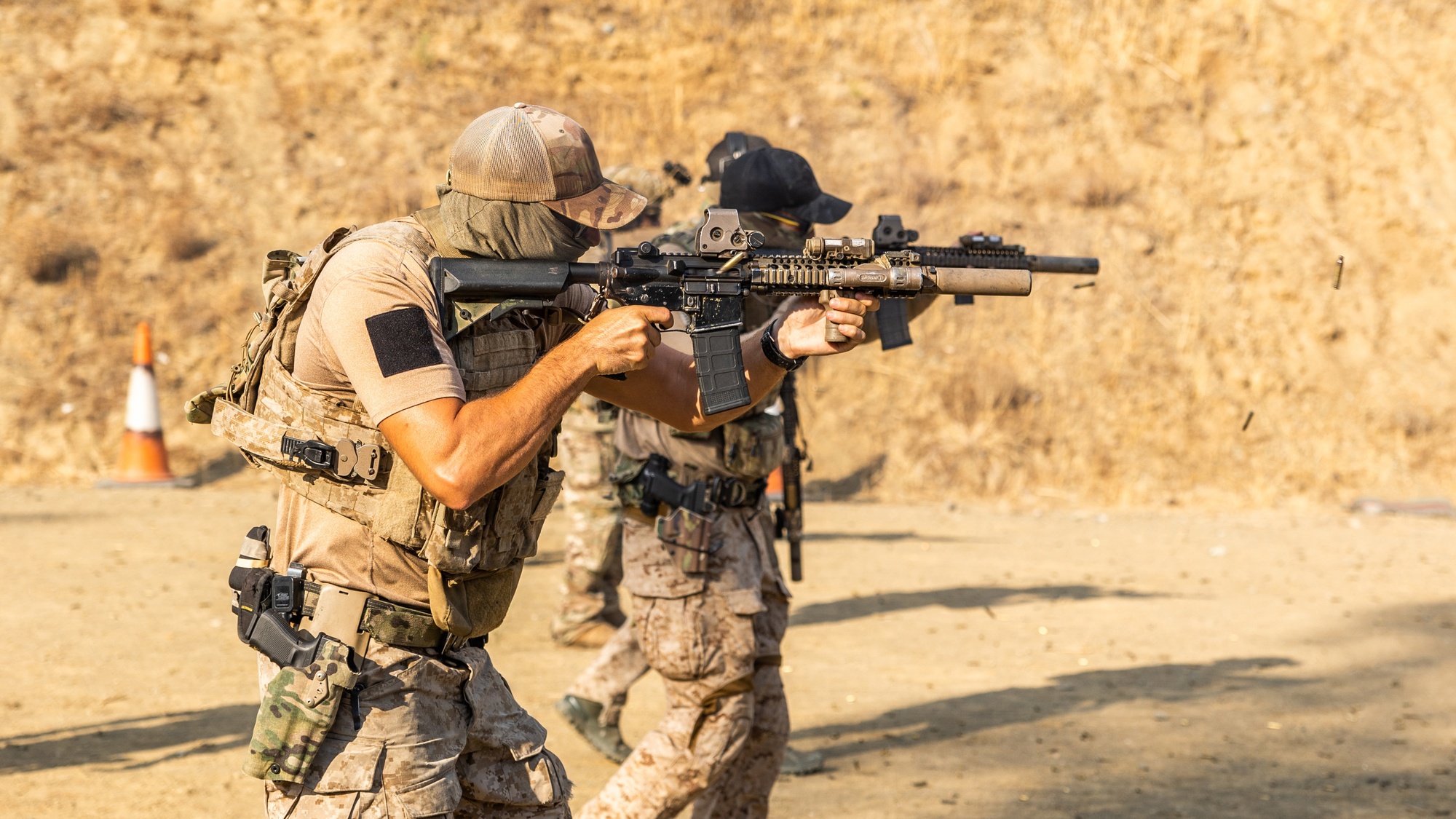
The Mk18 Mod 1 is the SOPMOD Block II configuration fielded from 2007, retaining the 10.3-inch Colt barrel but replacing the Mod 0's front sight post with a sightless low-profile gas block and the KAC quad-rail with the free-floating Daniel Defense RIS II handguard in anodized FDE.
How Daniel Defense became a SOCOM contractor
The Mk18 Mod 1 story is also a Daniel Defense story. Marty Daniel founded Daniel Defense in Savannah, Georgia in 2002 — born from custom rifle-accessory work he was doing for his own builds. The early Daniel Defense rail contracts established the company as a serious manufacturer, and by the mid-2000s DD was a known name in the small-arms-accessory industry. When SOCOM put out the Block II free-float rail solicitation, Daniel Defense was still small relative to KAC and ARMS — a Georgia shop competing against Knights Armament Company (the SOPMOD Block I incumbent) and ARMS (the Picatinny-rail pioneer).
Daniel Defense won the contract in 2006. The RIS II rail became the foundation of every Mk18 Mod 1 fielded for the next thirteen years and one of the most-recognized SOPMOD components in the U.S. inventory. The original production RIS II rails carry the "Savannah, GA" mark on the rail body — and surplus military examples (returned to the supply system, then liberated as "salty" used parts) are a treasure-hunt item among clone builders. A salty Savannah-stamped RIS II with combat wear is the gold-standard clone-correct rail for an operator-era Mk18 Mod 1 build. Daniel Defense subsequently moved down the road to a much larger facility in Black Creek, Georgia, and current-production rails bear the new home address. By the late 2010s, DD had grown into one of the country's largest firearms manufacturers. The SOCOM win was the inflection point.
The competition was won on engineering, not price. The KAC RAS clamped to the barrel nut with the barrel still inside the handguard — pressure on the rail still moved the barrel. The new requirement was a true free-float rail. Daniel Defense's response was the RIS II: a two-piece quad-rail handguard that removed the rifle barrel from handguard contact entirely. The RIS II FSP variant — 9.55" length, anodized FDE, with a front-sight-post cut-out — was the Mk18 spec. NSN 1005-01-548-1385. The 12.25" non-FSP variant was the M4A1 Block II spec.
One feature of the RIS II that gets misunderstood: the rail's integrated M203 grenade launcher hanger. SOCOM's requirement called for M203 compatibility in the rail design, and Daniel Defense engineered the hanger directly into the two-piece structure (the lower rail can be removed to mount an M203 without separate adapter hardware). But the M203 mounts to the 14.5" M4A1, not the 10.3" Mk18. The 10.3" barrel is too short — the M203's barrel-mount band has nowhere to grip, and the muzzle device sits where the M203 would. The RIS II's M203 capability was for the M4A1 Block II program; on a Mk18 it's vestigial. Some clone builders include the rail's M203 hanger anyway because the rail itself is the same part number, but no Mk18 ever mounted an M203 in operational use.
Fielding started in 2007 and reached broad SF distribution around 2010–2011, when every ODA member got a 10.3" Mod 1 alongside a 14.5" upper. The Mod 0 → Mod 1 transition is mechanical, not cosmetic: front sight post deleted, sightless low-profile gas block installed, full-length free-float DD RIS II mounted in place of the KAC quad-rail. The barrel free-floats, which restores accuracy under handguard pressure. That is why Mod 1 is a different rifle from Mod 0 — not because the handguard is a different color.
The transition was slower than the calendar suggests. SF veteran Jeff Gurwitch, writing for S.W.A.T. Magazine, didn't receive his first RIS II FSP until his second Afghanistan tour in 2014. Production capacity, contract logistics, and operator-level swap-outs meant Mod 0 and Mod 1 rifles ran side-by-side in SOF inventories for nearly a decade after the Mod 1 was "fielded." For clone builders, this matters: a 2007–2010 Mk18 in operator hands was almost certainly still a Mod 0 with KAC RAS, even though the Mod 1 was officially in service.
Paired with a SureFire SOCOM556 RC suppressor, the Mod 1 became the SF carbine of choice through the 2010s. Balance, handling, and acoustic signature — the package SF ODAs ran from Iraq's late surge through Afghanistan and into the post-2014 deployments.¹
The SOPMOD Block II accessory kit
The Mod 1 didn't ship to operators as a bare upper. It came with a full SOPMOD Block II accessory package — the modular kit that turned a 10.3" carbine into a complete close-quarters and short-range fighting system. The Block II kit, fielded alongside the RIS II rail starting in 2007, replaced the earlier Block I configuration that Mod 0 rifles had carried since 2000.
The headline Block II item was the ELCAN SU-230 SpecterDR 1-4x, a switchable-magnification optic that gave the operator a true 1x close-quarters sight at the flip of a lever and 4x magnification for longer engagements. SF veteran Jeff Gurwitch, writing in S.W.A.T. Magazine, called the SU-230 "the SOPMOD item that has made the biggest impact with Special Forces soldiers." Many operators piggy-backed a Docter or Trijicon RMR mini red dot on top of the SU-230 — a setup that became the visual signature of late-GWOT Mk18s.
Other Block II components: the AN/PEQ-15 ATPIAL aiming laser (IR plus visible red, zero-able in daylight, replacing the Block I PEQ-2 and PEQ-5), the Insight WMX200 LED weapon light as the program-issued light, and the SureFire SOCOM556 RC suppressor. The Mk18 itself was always the carbine, but the Block II accessory kit was what made it a complete weapons system.
SureFire on the Mk18 — the lights operators actually mounted
SureFire weapon lights are core to the Mk18 story across both Mods. Block I-era Mod 0 rifles ran the SureFire M900 / M900A — the lever-switch foregrip-style integrated light that was iconic on early-GWOT operator carbines. The SureFire M952V (white light plus IR LED for night-vision use) was the dual-output evolution and showed up extensively on SF and NSW rifles. Both M-series lights were Crane-blessed Block I accessories and appear in operator photographs throughout the 2000s alongside the Aimpoint M68 and KAC RAS.
Block II saw the program-issued light transition to the Insight WMX200 LED, but SureFire never left the platform. Operators continued mounting the SureFire M600 series Scout Light — particularly the M600U and later M600DF — as the standard compact white-light option on RIS II Mk18s. The SureFire M300 Mini Scout showed up on builds prioritizing weight reduction. By the modernization era, the SureFire M640V (white plus IR, dual-output successor to the M952V) became the Tier-1 unit signature light on current Mk18 builds, often paired with a Unity Tactical or Modlite pressure switch routed under the rail.
The pattern: SureFire's M-series foregrip lights defined the Mod 0 era; the M600 Scout Light family defined the Mod 1 era; the M600DF and M640V define current builds. For clone builders, the right SureFire is a year question — the lever-switch M900 reads 2003–2008, the M600U reads 2010–2018, the M640V reads 2020+. CCC stocks the full lineage across the CCC weapon lights inventory.
Mod 1 optics by era
The Mod 1 optic story breaks cleanly into three windows. 2007 to ~2014 was the regimented surge era — Crane- and SOPMOD-controlled fielding, big quantities, tight standardization. ~2015 to ~2020 was the maturation era — Block II inventory stabilized, EOTech zero-shift issues prompted operator-level swap-outs, individual selection widened. ~2020 onward is the modernization era — new contracts, new red dots, and the URG-I transition pulling LPVO mounting onto 14.5" rifles while Mk18s mostly stayed simpler.
2007–~2014 · The SOPMOD Block II surge
Fielding was tight by design. The post-9/11 surge was issuing rifles to tens of thousands of personnel; standardization mattered more than individual choice. Three optics dominated the Mod 1 in this era.
The ELCAN SpecterDR SU-230 1-4x — and its successor SU-230A 1.5-6x — was the headline magnified optic and the most-photographed sight on operator-era Mk18 Mod 1 rifles. Many operators piggy-backed a Trijicon RMR or Docter MRD mini red dot on top of the SpecterDR rail for true close-quarters work — the SpecterDR + RMR stack became the visual signature of late-GWOT Mk18s.
The EOTech 553 / SU-231 and its successor EXPS3-0 / SU-231A were the holographic options. Both ran the EOTech reticle pattern with the unlimited eye-relief the brand is known for. The Trijicon ACOG TA31ECOS 4x with a piggy-backed Docter MRD was the fixed-magnification combat optic for shooters who wanted ACOG glass and BDC precision plus a 1x backup. The Aimpoint M68 carried over from Mod 0 and stayed in use on Mod 1s, particularly for pure CQB roles.
~2015–~2020 · The maturation era
Operator-level optic selection widened as Block II inventory stabilized and the contracts that defined the SOPMOD II palette aged out. EOTech's well-documented zero-shift and temperature issues — which culminated in the 2016 Pittman v. L-3 Communications EOTech lawsuit — pushed some operators away from the 553 / SU-231 and toward the EXPS3-0 or back toward magnified optics. The Trijicon VCOG 1-6x appeared as a VCOG alternative to the SpecterDR for shooters who wanted variable magnification in a more conventional scope body. The EOTech G33 magnifier behind a holographic became a common operator-level addition for stretch shots — a CQB-fast 1x with a flip-to-3x option.
~2020 onward · The modernization era
The Mk18's modern optic landscape is narrower than the M4A1's, because the Mk18's 10.3" barrel limits effective range. Most of the new contracted variable-magnification optics — the Sig Sauer Tango6T 1-6x on the USSOCOM Squad-Variable Power Scope contract, the Vortex Razor HD Gen III 1-10x on the Army Squad-Common Optic program — are built for 14.5" platforms where the magnification matches the barrel's effective envelope. On the Mk18, these scopes are possible but uncommon; the 10.3" barrel's effective range with Mk 262 caps around 500 m, and a 1-10x LPVO is more scope than the rifle's ballistic envelope justifies.
What the modern Mk18 actually wears is simpler. The Aimpoint Micro T2 on a Scalarworks LEAP mount is the documented current NSW signature compact red dot — recent SEAL training imagery shows it on Mk18s, low-profile, 50,000-hour battery life, the natural successor to the M68 on a 10.3" CQBR. The Aimpoint COMP M5 is the conventional-force red dot that replaced the M68/CompM4 and runs alongside the Micro T2 in current inventory. EOTech EXPS3-0 and Trijicon RMR HD round out the modern red-dot / holographic landscape. The SpecterDR is still on plenty of operator Mk18s; the kit doesn't get replaced just because newer options exist.
For clone builders, the right Mod 1 optic depends on the year, the unit, and the mission. A 2009 SF ODA build leans ACOG or EOTech 553. A 2014 NSW build leans SpecterDR with an RMR piggy-back. A 2025 NSW build leans Aimpoint T2 on a Scalarworks LEAP. The variable-magnification LPVOs that have dominated post-2020 contract awards belong primarily on 14.5" M4A1 / URG-I rifles — they show up on Mk18s but aren't the platform-correct default. CCC stocks the full optic landscape across the optics inventory.
Mk18 Mod 1 Specifications
The most-cloned Mk18 — Block II as the U.S. Navy carried it
- Colt M4 upper · Colt 10.3" Government-profile barrel · Daniel Defense RIS II in anodized FDE (Savannah-stamped where possible)
- Sightless low-profile gas block · KAC folding front sight (P/N 99051) · KAC folding rear BUIS
- Colt full-auto BCG · PRI Gas Buster M84 · LMT/B5 L7LA2B SOPMOD stock · SureFire SOCOM2-556-ready muzzle device
The Tuning Trifecta: Gas Port, Buffer, Ammunition
One specification almost no civilian article carries correctly: the canonical 0.070" gas port is current spec, not original. The 0.062" port carried over from the parent M4 14.5" barrel. The move to 0.070" was a 2017-era retuning in response to reliability problems with the original 10.3" CQBR builds. Garand Thumb confirms it on the bench: short dwell time, larger port, ammo-and-buffer balance.
| Variable | Spec | Ammunition Pairing |
|---|---|---|
| Gas port | 0.062" → 0.070" post-2017 | Tuned with ammo and buffer |
| Buffer H | Standard heavy | M193 / M855 (62-grain general issue) |
| Buffer H2 | Heavier | Mk 262 77-grain, Mk 255 R2LP, Mk 311 R2LP |
| Buffer H3 | Heaviest | Extreme case; eroded gas port compensation |
The preferred CQBR load is Mk 262 Mod 1: 77-grain Sierra MatchKing OTM, developed by Black Hills Ammunition for the Mk12 SPR program at NSWC Crane. Two Crane projects, one ammunition solution. Mk 262 runs 3,071 ft/s from a 20" barrel and 2,489 ft/s from a 10". Effective range stretches from ~300 m on general-issue 5.56 to ~500 m on Mk 262 with the right optic.
The 5.56 fragmentation threshold is approximately 2,600–2,700 fps. M193 and M855 from a 10.3" sit right at that threshold and lose fragmentation reliability past ~100 meters. The 77-grain Mk 262 mitigates this because it relies less on velocity for terminal effect — which is why Crane standardized on it for the platform. The Mk 262 family expanded over time: Mk 318 SOST (Mod 0 and Mod 1, 62-grain barrier-blind round developed for MARSOC), Mk 255 R2LP (reduced-ricochet limited-penetration for VBSS), and Mk 311 R2LP (a follow-on R2LP load) all run cleanly through the same 0.070" gas-port H2-buffer setup. Running a Mk18 for serious use means running Mk 262 or one of its Crane-developed siblings.
What wears out, and how fast
The Mk18's 10.3" barrel runs higher chamber pressure and shorter dwell time than a 14.5" M4A1. That has measurable consequences for parts life. Real-world numbers from operator builds:
- Barrel life: ~6,000–10,000 rounds before accuracy degrades meaningfully on a Colt chrome-lined Government-profile 10.3". Suppressed use shortens this — the suppressor traps heat against the muzzle and accelerates throat erosion.
- BCG / bolt: Expect to inspect every 3,000–5,000 rounds, replace the bolt at 8,000–10,000 rounds. Suppressed use again shortens cycle life — the back-pressure spike accelerates lug-shear and extractor wear.
- Extractor & ejector springs: 5,000–7,500 rounds typical. The five-coil COTS spring + O-ring stack extends this versus the four-coil mil-spec.
- Buffer spring: Inspect at 5,000 rounds; replace at 10,000.
- Gas rings (one-piece McFarland): ~10,000–15,000 rounds before the spec drops below acceptable. Three-piece sets are shorter-lived.
Operator builds frequently run a Vltor A5 or rifle-length buffer system to slow bolt-carrier velocity and stretch the wear envelope — clone-correct rifles use H/H2/H3 carbine buffers and accept the shorter parts life as the cost of period-correctness.
The Modern Mk18: The "Mod 3" Configuration
The Mk18 Mod 3 is the colloquial label for the current-issue Navy NSW configuration — an 11.5-inch Colt Government-profile barrel paired with a Geissele MK16 SMR M-LOK handguard that replaced the Daniel Defense RIS II quad-rail. The Mod 3 designation is not a published NSWC Crane type-classification; it is community shorthand for the modern configuration.
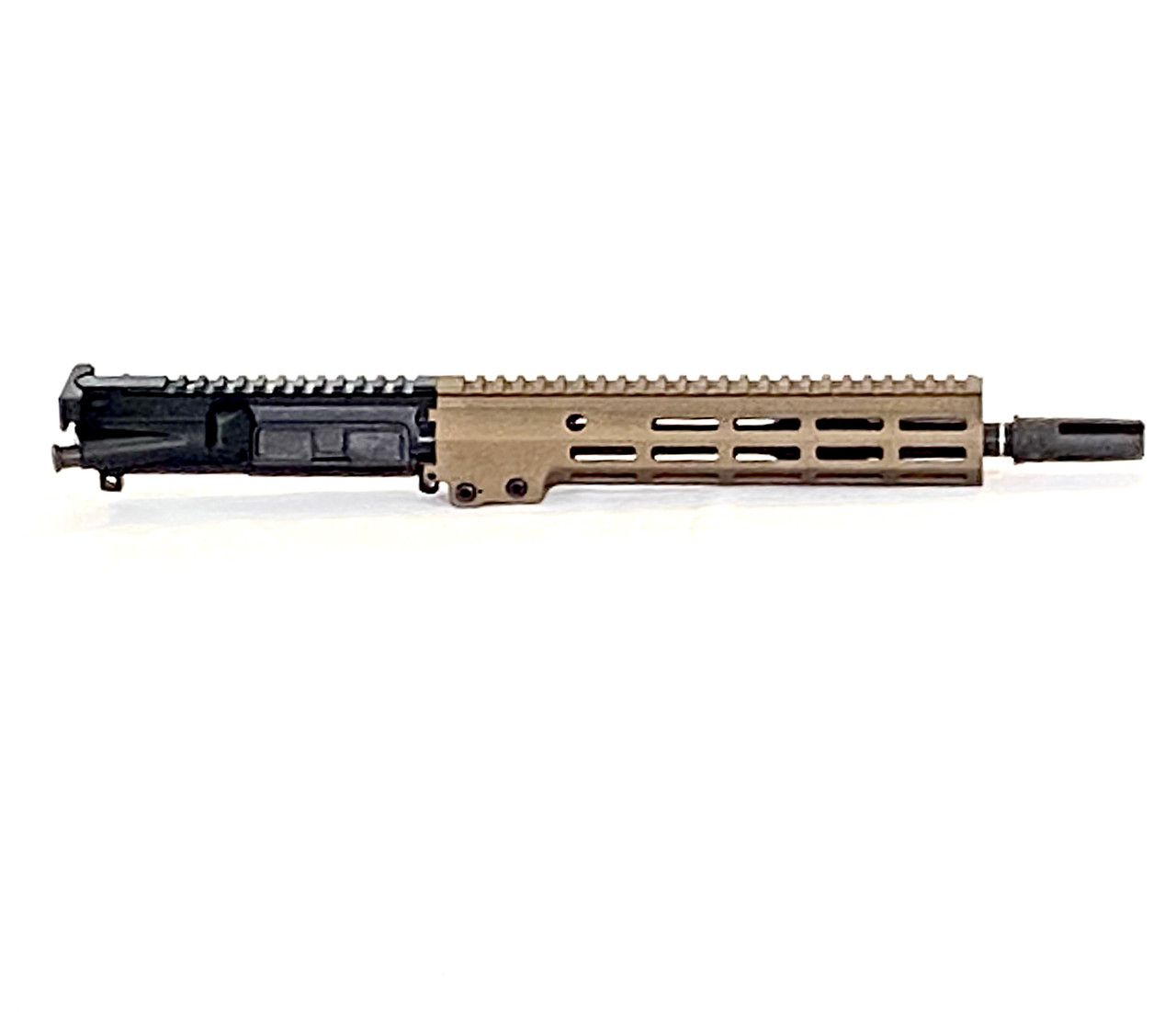
Around 2018, the modern M-LOK rail family began replacing the DD RIS II quad-rail on Crane-spec rifles. Naval Special Warfare's current-issue Mk18 — what the community calls the Mod 3 — pairs an 11.5" Colt Government-profile barrel with a Geissele MK16 SMR M-LOK handguard. Same Colt forging as Mod 0 and Mod 1. Same FSP-deleted gas block as Mod 1. Carbine-length gas system. The configuration name "Mod 3" is community shorthand — no published NSWC Crane type-classification document carries the designation.
It's not an official designation. Wikipedia's canonical CQBR table contains only Mod 0, Mod 1, and the URG-I — no Mod 2, no Mod 3. But the configuration is real, it's in current Navy service, and it shares the modern M-LOK rail family with the broader URG-I program — the Army's M4A1 upgrade path runs on the same Geissele MK16 SMR architecture. The Mk18 Mod 3 is the NSW 11.5" CQBR-length expression of that modern architecture.
Mk18 Mod 3 Specifications
Current-issue NSW configuration — Colt + Geissele MK16 M-LOK
- Colt M4 upper · Colt 11.5" Government-profile barrel · Geissele MK16 Super Modular Rail (M-LOK)
- Sightless low-profile gas block · Modern folding BUIS · Colt full-auto BCG
- PRI Gas Buster or Geissele ACH · B5 SOPMOD stock · SureFire SOCOM2-556 ready
At a Glance: Mod 0 vs Mod 1 vs Mod 3 vs GL/SSC
For builders comparing configurations side-by-side, the four canonical Mk18-family variants line up like this:
| Spec | Mod 0 | Mod 1 | Mod 3 | GL/SSC |
|---|---|---|---|---|
| Era | 2000–~2010 | 2007–~2019 | ~2018–Present | ~2014–16 mil / 2026 commercial |
| Barrel Length | 10.3" | 10.3" | 11.5" | 12.5" |
| Handguard | KAC RIS / RAS quad-rail | DD RIS II FSP quad-rail | Geissele MK16 SMR (M-LOK) | DD GL/SSC RIS II quad-rail |
| Front Sight | A-frame F-height FSB | Sightless low-profile gas block | Sightless low-profile gas block | Sightless low-profile gas block |
| M203 Compatible | No | No (rail supports, barrel too short) | No | Yes (integrated hanger) |
| Primary Users | NSW SEALs, broader SOCOM | All USSOCOM, SF, NSW | NSW current issue | Limited SOCOM trickle |
| Status | Wikipedia-documented | Wikipedia-documented | Colloquial, no Crane designation | Documented but rare |
The 12.5" GL/SSC: 100 Rifles, One Contract, a 2026 Return
The rarest documented Mk18-family configuration is the GL/SSC RIS II — Grenade Launcher, Sound Suppressor Capable. A Daniel Defense rail variant designed around a 12.5" barrel that retains M203 mounting and clean suppressor compatibility on the shorter platform.
Per Soldier Systems Daily's October 2016 reporting, only 125 GL/SSC rails were ever produced. 100 went to military end-users. 25 reached civilian hands. The civilian 25 were not on the open market — they went to people Daniel Defense knew. Builders chased the configuration for years and couldn't find it. The military rifles were carried, photographed sparingly, and never broadly publicized. No DEVGRU standardization. No published Crane type-classification. A 100-rifle special-mission trickle.

At SHOT Show 2026, Daniel Defense reintroduced the GL/SSC as the GL/SSC URG and a complete GL/SSC SBR. First general-public availability since the original SOCOM-era contract. The commercial product carries the same 12.5" barrel, carbine gas system, and integrated M203 hanger that defined the military rails.
DD Commercial vs. Clone-Correct: What You're Actually Buying
The Daniel Defense commercial Mk18 is a real Mk18 in the sense that DD says so and the platform genealogy holds — they make the rail Crane specified, they make the barrel to the same dimensional spec. But it is not what an NSW operator pulls off the rack. Three things separate the DD commercial Mk18 from a Crane-spec clone:
- Receiver. Military Mk18 = Colt upper with CAGE codes. DD commercial = DD upper with DD branding.
- Barrel. Military Mod 1 = Colt barrel. DD was the rail contractor, not the barrel contractor. DD commercial = DD's own CHF barrel that runs to spec, just not the Colt barrel Crane bought.
- Rail generation. DD Mk18 Mod 1 SBR ships with the DD RIS II (matches military Mod 1). DD Mk18 RIII ships with DD's M-LOK successor — DD's own evolution, not the Navy's "Mod 3."
Daniel Defense's current commercial Mk18-family lineup runs three configurations: the DD Mk18 Mod 1 SBR with the 10.3" barrel and original RIS II quad-rail, the DD Mk18 RIII with the 11.5" barrel and DD's M-LOK successor rail, and the new DD GL/SSC URG with the 12.5" barrel and the reintroduced GL/SSC RIS II. Three barrel lengths, three rail generations, all DD-built, all real. Charlie's Custom Clones stocks all three alongside our clone-correct Crane-spec builds. Both paths are legitimate. Confusing them is the trap.
Where the Mk18 Is Today
The Mk18's user list is broader than most articles acknowledge — and it grew that way because the platform earned the spread.
Naval Special Warfare remains the original and largest U.S. user base. SEALs on both coasts run Mk18s for VBSS, hostage rescue, and direct-action work; the rifle has been in continuous NSW service since 2000. No replacement is in program. The platform's connection to the Navy is structural — Crane is the Navy's small-arms technical authority, the "Mk" designation is Navy nomenclature, and every Mod-series revision traces back to a Crane process decision.
USSOCOM elements adopted the Mk18 in waves through the GWOT years. Green Berets and SF ODAs carried the Mod 0 from around 2004, the Mod 1 from 2010–2011. The 75th Ranger Regiment runs Mk18s in the same direct-action role NSW carved out. MARSOC Critical Skills Operators and Marine Force Reconnaissance both adopted the platform for close-quarters work where the M4A1's length was a liability. DEVGRU, Combat Applications Group, and Intelligence Support Activity all have Mk18s in inventory, though the HK416 has displaced the Mk18 in some Tier 1 unit roles. The 2019 USSOCOM transition to the 11.5" URG-I shifted SF carbine use away from the Mk18 Mod 1 specifically — but the 10.3" CQBR length, in its modern Mod 3 / URG-I family configuration, remains in active inventory across the major USSOCOM elements.
The U.S. Coast Guard picked up the Mk18 early. The platform fit Coast Guard mission profiles before the Coast Guard asked — boarding hostile vessels, clearing belowdecks compartments, working from RHIBs. Coast Guard Maritime Security and Safety Teams (MSST), Maritime Security Response Team (MSRT), and Maritime Law Enforcement Specialists in Deployable Specialized Forces and Tactical Law Enforcement Teams all run the Mk18 in 2026.
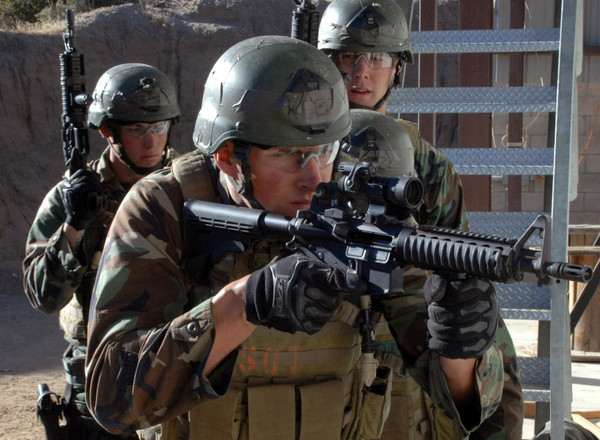
U.S. Navy EOD operators carry the Mk18 for close-protection work in active combat zones. The hero image on this post is a Navy EOD operator with the platform — the rifle is core to their mission set, not a peripheral kit item. NCIS agents deploying to active combat zones have been issued the Mk18 since 2006; for plainclothes-but-armed federal investigators working alongside SOF, the platform's compactness and 5.56 terminal performance beat an MP5.
Air Force Special Operations Command is the heaviest URG-I user in the U.S. inventory. AFSOC's 10.3" CQBR-length URG-I variant is the closest current-issue cousin to the Navy "Mod 3" — same Geissele MK16 SMR rail family, same FSP-deleted gas block, same 10.3" barrel. AFSOC's pararescue and combat controller elements run them for the same reasons NSW does: short, suppressed, accurate enough out to roughly 300 meters with Mk 262.
State and local law-enforcement SWAT teams across the U.S. have adopted the Mk18 widely. The platform's short length, controllability, and 5.56 terminal performance fit SWAT mission profiles — high-risk warrant service, hostage rescue, active-shooter response. Most SWAT-issued Mk18s are commercial Daniel Defense or Colt versions rather than NSW Crane-spec rifles, but the silhouette and capability are the same.
Combat use in Ukraine

The platform's relevance is not historical. Open-source reporting documents the Daniel Defense RIS II and Mk18-pattern 10.3" carbines in active combat use by Ukrainian forces and allied volunteers. The rail durability Garand Thumb tested on the range is being validated in conventional war in 2026. The image to the right is from exercise Sea Breeze 21 in Ochakiv, Ukraine — July 2021, just months before the Russian invasion. NSW SEALs were on the same Black Sea coast training their Ukrainian counterparts on the same rifle that Ukrainian assault elements would carry into combat the following year.
The newer DD M4A1 RIS III — Daniel Defense's M-LOK successor to the RIS II — is also in documented Ukraine service. Garand Thumb's 2025 durability testing of the RIS III confirmed the rail's published combat-validation claims: zero retention through extended abuse, no rail flex under bipod or VFG load, no failures in the suppressed firing cycle. The Mk18 family is not a museum piece. Twenty-seven years after a Crane gunsmith took a hacksaw to a 14.5" M4 barrel, the rifle that came off that bench is in conventional combat across two theaters.
Reference: Platform Development Timeline
Mk18 / CQBR · 1989–2026
Mk18 Build FAQ — Forum Debates Settled
The questions that come up over and over on AR15.com, M4Carbine.net, r/MilitaryARClones, and clonerifles.com — answered to the documented record.
The Most-Asked Clone-Builder Questions
Is there a Mk18 Mod 2?
No. The NSWC Crane type-classification table contains Mod 0, Mod 1, and the URG-I variant — no Mod 2. The label appears in marketplace listings but has no documented basis.
Was the Mk18 used at Operation Neptune Spear?
No. Post-mission reporting credits the HK416 as the DEVGRU Red Squadron primary rifle at the May 2, 2011 raid on Abbottabad. The Mk18 was broader NSW general-issue but not the documented Neptune Spear rifle.
What's the difference between "Mk18 Mod 1" and "CQBR Block 2"?
Same rifle, different service nomenclature. "Mk18 Mod 1" is Navy (Crane controls Navy SOF small-arms designations). "CQBR Block 2" leans Army (SOPMOD Block program designations). Some receivers are marked "Navy 18-1" or "CQBR 2." Both terms describe the same DD RIS II-era CQBR.
Did Daniel Defense make the military Mod 1 barrels?
No. DD won the SOCOM contract for the RIS II rail, not the barrel. Military Mod 1 barrels remained Colt-supplied. DD makes their own 10.3" Cold Hammer Forged barrel for the commercial DD Mk18 SBR — same dimensional spec, just not the contracted military barrel.
What's the canonical gas port size on a Mk18?
0.070" is current. The original Crane CQBRs ran 0.062" (carried over from the M4 14.5" barrel). Crane retuned to 0.070" around 2017 in response to reliability problems with the 0.062" port + Mk 262 + suppressor combination. Both numbers are correct for their respective eras.
Is the Mod 0 barrel SOCOM-profile or Government-profile?
Government profile. The original Mod 0 barrels were standard 14.5" Colt M4 Government-profile barrels cut to 10.3". Some sources describe them as "SOCOM profile" but the documented Crane process used Government profile.
Are P&S Products / PAT parts as good as KAC originals?
Yes. P&S/PAT was KAC's licensed second-source contractor for the M4 RAS, VFG, rail covers, and Colt's M4 stocks. Same DOD spec, same dimensions, same materials. A PAT-marked part is period-correct for any clone era it would appear in.
What's the right rear sight for a clone-correct Mod 0?
LMT L8A fixed rear sight for the bulk of the operational era. The earliest 2000–~2002 Mod 0 rifles ran chopped A2 carry handles as a field-expedient sight; LMT's purpose-built L8A replaced them as production matured.
Did anyone ever mount an M203 on a Mk18?
No, not in documented operational use. The 10.3" barrel is too short — the M203's barrel-mount band has nowhere to grip, and the muzzle device sits where the launcher would. The RIS II's integrated M203 hanger was designed for the 14.5" M4A1 Block II, not the Mk18. The GL/SSC RIS II at 12.5" is the only Mk18-family barrel length that physically supports an M203.
What's Actually in a Clone-Correct Mk18 Upper
One question worth addressing directly: why does a clone-correct Mk18 Mod 1 upper cost what it costs? The clone community has, fairly, asked that question of CCC and shops like CCC for years. The honest answer is parts sourcing.
A clone-correct Mk18 Mod 1 upper isn't expensive because of markup. It's expensive because of what goes into it. Walk down the parts list:
- Colt M4 upper receiver — Colt is the originator and the only U.S.-government-contracted M4 manufacturer. Their forgings carry the proper CAGE codes, interior white T-marks, and roll-marks the military Mod 1 used. There is no substitute that's clone-correct.
- Colt 10.3" Government-profile barrel — Crane-spec, chrome-lined, F-height FSB factory-pinned. Available, but on a limited and intermittent production cycle. Stocking inventory means buying when Colt produces.
- Daniel Defense RIS II in anodized FDE — current production runs are correct; the gold-standard Savannah-stamped surplus rails are increasingly rare and command a meaningful premium when they surface "salty" from returned military inventory.
- Colt full-auto BCG with proper staking — full-auto carriers, chrome-lined, with documented MPI/HP testing. Commercial "M16-cut" carriers are not the same part.
- PRI Gas Buster M84 charging handle — small part, real money, period-correct.
- KAC folding front sight (P/N 99051) in FDE/taupe — KAC-manufactured, not a commercial equivalent.
- KAC folding rear BUIS — KAC-only, period-correct for the Block II era.
- SureFire SOCOM2-556 ready muzzle device — the SureFire SF4P closed-tine or equivalent threaded for the SOCOM-series suppressor mount.
Every one of those parts is a verifiable, contract-spec, period-correct component. There are cheaper substitutes for most of them — and a thoughtful near-clone build (using the decision table in the Mod 0 section as a guide) can land at a real fraction of the all-original cost. CCC sells both paths. The clone-correct build costs what it costs because the parts cost what they cost. The shop's margin is in the assembly and the QC, not in the markup on the components.
If you're price-sensitive, build the near-clone and put the savings into ammunition and training. If you want the rifle the Navy actually carried, the parts list above is what you're paying for. Both are honest answers.
Sources & Editorial Notes
Primary published sources
NDIA Joint Services Small Arms Symposium archives (Taylor, 2003 · Taylor/Glenn/Campion, 2006 · Taylor/Gatewood, 2007). Defense Acquisition University, "NSWC Crane Saves $970K for NAVSEA Small Arms Office," 22 August 2008. Small Arms Review, "U.S. Navy Mk18 Mod O Custom Close Quarter Combat Weapon," 5 April 2008. Soldier Systems Daily, "Rare Sighting Of A Daniel Defense GL/SSC RIS II," 20 October 2016 (primary source on GL/SSC production numbers). The Firearm Blog, "[SHOT 2026] Daniel Defense GL/SSC Re-issue." Daniel Defense product documentation (Mk18 SBR, GL/SSC URG, RIS II). Wikipedia CQBR type-classification table.
SME video sources
Garand Thumb (Mk18 Mod 0 review · Mod 1 setup · short-barreled 5.56 ballistics with Administrative Results · DD M4A1 RIS III Ukraine combat-validation review, 2025). Modern Tactical Shooting (firsthand Army Special Forces deployment account, Iraq and Afghanistan, ~2004–2019). Foghorn 5 (Mk · Mod · Block · A terminology). Classic Firearms and Small Arms Solutions (platform history, current users, reliability package).
Editorial notes
Approximate dates. Where "~around" precedes a year, the underlying record carries some uncertainty. Military fielding rolls out unevenly across units; contract-award and broad-distribution dates differ.
Mod 1 vs. CQBR Block 2. Foghorn 5 argues that "Mk18 Mod 1 never existed" — that all post-Mod 0 builds are properly "CQBR Block 2," with some receivers marked "Navy 18-1." Canonical sources (Wikipedia CQBR, SAR, Daniel Defense's own product nomenclature, firsthand SF accounts) use "Mk18 Mod 1." We follow canonical naming.
Mod 0 barrel profile. Garand Thumb describes the Mod 0 barrel as "cut-down SOCOM profile." The primary record and CCC's own product copy reflect the canonical position: standard Colt M4 14.5" Government-profile barrels cut to 10.3", not SOCOM-profile.
Vltor A5 and rifle-length buffer setups seen on operator builds (including Garand Thumb's range setup) are personal preferences for parts-wear management — not Crane-spec, not clone-correct. Crane-spec Mod 1 ships with H, H2, or H3 carbine buffers.
¹ SureFire SOCOM2-556 as clone-correct replacement. The original SureFire SOCOM556 RC is period-correct for the SOPMOD Block II Mod 1 era. SureFire no longer produces the original RC. The SOCOM2-556 is the current production successor and is generally accepted as the clone-correct replacement for both new builds and operator-era restoration work — the design and external profile are close enough that the platform reads correctly with either. Use the SOCOM2 for a build you intend to actually shoot.
Charlie's Custom Clones has been building Mk18 clones since 2017. We are operated by Potomac Armory. Every clone-correctness assertion in this post traces to a build we have shipped, a part we have stocked, or a Crane process verified through SME networks.
Shop the Mk18 Platform at Charlie's Custom Clones
We stock the full Mk18 upper receiver lineage. The Mk18 Mod 0 near-clone with Colt 10.3" barrel and Troy M4 RAS handguard. The Mk18 Mod 1 Military Special Edition with Colt forging, Colt 10.3" Government-profile barrel, DD RIS II in anodized FDE, Colt full-auto BCG, and PRI Gas Buster — clone-correct top to bottom. The Mk18 Mod 3 with Colt 11.5" barrel and Geissele MK16 SMR. And the new 12.5" Daniel Defense GL/SSC URG for the rarest documented Mk18-family configuration. We are operated by Potomac Armory and have been building Mk18 clones since 2017.
Browse Mk18 CQBR uppers in inventory, the URG-I upper receiver category, or contact us for a custom build consultation.