
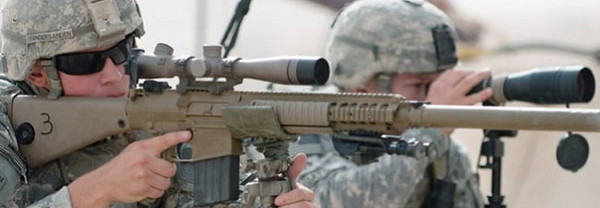
Precision barrel making: the Mk11 and M110
Posted by Charlie's Custom Clones on Dec 18th 2018
Last updated: December 18, 2018
Precision Barrel Making: The Mk11 and M110 Story
For over a year, we've been re-engineering replacement barrels for the Mk11 and M110 military sniper rifle — pulling in master craftsmen like Boots Obermeyer, reproducing the original Mk11 gas block from an authentic deployment kit, and learning more than we ever expected about 5R rifling, .298 chambers, and what it takes to perfectly clone a Knights Armament barrel.

Why We Set Out to Build Mk11 and M110 Barrels
So, this is more of an update than an interesting learning article. Many of you know that we have been working on a design of replacement barrels for the Mk11 and M110 military sniper rifle. This started out of necessity — we wanted to build a few precision clone rifles, and the rifle manufacturer either no longer made the barrels and/or was restricted by military contract in selling them to civilians or who knows what. They just were not available.
So, for the last year, we have been re-engineering, designing, employing experts and craftsmen and learning. I am humbled at the talent that we have brought to bear for this labor of love. And, we will have barrels for delivery in March (2018).
This is a slow process. Every week, I say… Next week…
Headspacing the .308 Bolt Question
This week was our next-to-final testing. We used both a KAC and an LMT bolt, and they were identical as to headspacing. I thought they might be. I dredged up a four-year-old thread on .308 bolts, and the contributors found that LMT, KAC, LaRue, Armalite and JP all had an identical or close-to-perfect match (read the Sniper's Hide thread →). Well, I thought, voilà — we are good to go.
Well, my barrel engineer — they are an odd lot, but you need them to be odd — says, "all we really know now is that these two bolts are identical. We don't know if they are average, or thick or thin compared to others." Shit, I said. Now what? He's recommending that we individually headspace each bolt as we tighten the extensions on. "If," he said, "we had a bolt drawing for a KAC or LMT, then we would know something" — which is why you don't need to headspace AR15 barrels: there's an exact spec to build to.
That adds a little wrinkle. But if all the above bolts are the same, and we know that LMT and KAC parts are pretty much interchangeable, then I suppose I can offer the alternative of a matching LMT BCG. (I have no clue if an LMT bolt will fit in a KAC carrier, but I know that either full BCG will fit in either gun — the SR25 or the 308MWS.) I can also buy LMT BCGs, and if someone chooses not to buy the BCG with the barrel, then put that one back in the lot to be headspaced to another barrel. I am not sure what else to do.
Rebuilding the Mk11 Gas Block from a 2001–2004 Deployment Kit

Almost as hard as the barrel has been the design and build of a Mk11 gas block. Many think the gas block is the same as the M110, and late in its life it was, especially as the Mod 1 started to dawn in 2008 or so. But in its first days, the Mk11 had a more solid gas block.
So we have re-manufactured the Mk11 gas block as it existed in 2001–2004. We were lucky enough to find an original deployment kit, and getting the dimensions right — especially the suppressor-mount profile — meant measuring, machining, re-measuring, and confirming that a period-correct Mk11 KAC suppressor would lock up cleanly. Now, the testing on the gas block dimensions — and making sure we could attach a Mk11 suppressor — OMG!
Mk11 vs M110 Gas Block — Quick Reference
- Mk11 Mod 0 (2001–2004): Heavier, more solid block — the version we reproduced
- Mk11 Mod 1 (~2008–onward): Began converging with the M110 design
- M110 SASS: Lighter, later-spec block — KAC in-house production
- Suppressor compatibility: Mk11 KAC suppressor mount requires the correct profile
Mr. Obermeyer and the 2017 Barrel Production Run
On the barrel front, we got Mr. Obermeyer to give me his entire 2nd-half 2017 production of barrels, which averaged a little less than one per week. Yeah, a little less than one every other week.
Mr. Barrett "Boots" Obermeyer (he asked me to call him Boots, and there IS a story there) is an incredibly talented and humble man. Boots has been a barrel maker for years, and to look inside his shop, his equipment has to be from before WWII. But that was when great machining was an art.
The 5R Rifling Process
Boots took up machining and moved into barrel making. He was an early innovator. He pioneered what is now the best rifling around, used by Krieger and Bartlein and others: the 5R rifling process. I understand the "R" is for Russian, but that is all I know — other than the rifling has five edges instead of six, with sloped land transitions that ride the bullet jacket more gently.
He created what is now known as the Obermeyer chamber for 7.62mm NATO rounds, and also experimented with barrel diameters, landing on a tight chamber for the .308 — reducing the barrel inner diameter by .002" to squeeze the bullet and get the five grooves deep into the copper for what he felt was improved accuracy. He, in fact, proved that to be the case when using the M118LR military sniper round.
.298 vs .300 Bore — The Tight-Chamber Debate
Today, the Obermeyer .308 and the Knights Armament SR25 barrels are actually tighter than other barrels. Most barrels have a .300/.308 diameter for lands and grooves, but these two manufacturers use a .298/.308. Seems small to you and me, but it is a hot topic of debate. In talking with Bartlein, they advised against it. It turns out that the .298 chamber size is best for the high-mass bullets — like the 168 and 175 grain — but should not be used with ball ammo.
Why the .298 Bore Matters
- Tighter fit: .298 lands vs. industry-standard .300 squeeze the projectile harder into the grooves
- Best with match ammo: 168gr / 175gr Sierra MatchKing and M118LR loadings
- Not for ball ammo: Avoid M80 ball — pressure spikes possible
- Used by: Obermeyer .308 and Knights Armament SR-25 / Mk11 / M110
A Tribute to Boots Obermeyer
Boots gave us his entire production capacity for the last six months of last year, before suffering a stroke in late December. I spoke with his wife. He is doing well, going to physical therapy, but has some nerve issues on the left side of his body. Boots is somewhere in his 80s, I would guess — and is an inspiration to us all. Keeping up his work. The work being the love of his life, along with his wife.
It was a different time in America when Boots first went to work. As I recall his story, his father owned the country store and he worked there as a child. He wanted to do something different. He studied engineering, as I remember, but did not finish college. He went into the military and did some spook work in military intelligence, weapons design, and communications before starting his business. He never really retired. Sometime back in earlier years, he was a champion marksman.
Many of the current barrel makers learned what they know today from Boots. It is a very tight-knit community. John Krieger learned the cut-rifling process under Boots and purchased the same Pratt & Whitney hydraulic rifling machines as surplus sometime after the War. Steve Dahlke at Criterion spent 30+ years with Krieger.
Last year, we asked Boots how many barrels he could make. He told us "one a week" was a good number, and we agreed on that. One day, I hope to continue to work like Boots into my 80s.
Obermeyer Barrels in the Mk11 Mod 0 Era
The very first barrels that Knights used in the SR25 sniper rifle, and later the Mk11 Mod 0 starting in late 2001, were all from Boots Obermeyer. The first were stainless in the white, then blackened stainless, and later Parkerized and Cerakoted black Chrome-Moly.
I asked him how many barrels he made. He was a little evasive — but I suppose that was his G2 heritage. From some of the numbers I have seen, the Mk11 Mod 0 had a little less than 400 produced before the Army got involved and the Mod 1 / M110 came into production. Somewhere around that point, KAC took barrel production in-house. I am not sure if any Obermeyer barrels made it into the M110. Boots told me he ramped up production but could not keep up with the volume KAC needed — so it sounds like the first round of M110 barrels were Obermeyer. I personally have only seen his marks on the Mk11.
Mk11 Mod 0 Production Timeline
- Late 2001: First Knights SR25 / Mk11 Mod 0 barrels — all Obermeyer
- 2001–2005: ~400 Mk11 Mod 0 rifles produced
- ~2008: M110 SASS adopted by U.S. Army; KAC takes barrel production in-house
- First-run M110 barrels: Likely still Obermeyer during ramp-up
What's Coming: Charlie's Mk11 and M110 Barrels

When we go to production here shortly, there will be a limited run of Obermeyer barrels and also some other commercially made blanks at different price points. The M110 will probably not have the Obermeyer barrels.
We will also have a limited supply of M110 flash hiders, as well as KAC URX rails for both Mk11 and M110. I also have a pretty good supply of optics for those interested — I got a special military run of the M110 optic, and the Mk11 Leupold is in ample supply.
Other Mk11 / M110 Parts We've Stocked
M110 mounts and flash hiders are still in production at KAC. Mk11 rings from KAC, as well as Mk11 front flip-up sights, are rare as hens' teeth. I am looking at different options for the Mk11 rings that have the same look but not the same quality. So, who knows.
Ready to Build Your Mk11 or M110 Clone?
Browse our curated inventory of Mk11 and M110 uppers, barrels, gas blocks, rails, and KAC components — the most complete civilian source for these platforms.
Shop Mk11 & M110 Parts → Browse Complete KAC SR-25 / M110 →Thanks for reading. And look for our barrels at Charlie's Mk11 and M110 barrels.